The secret to how to style a bookshelf like a designer is not owning a perfectly curated collection of pottery or having shelves tall enough for an English library. It is learning to balance practical storage with a little personality. A bookshelf should hold the things you reach for, remember, and enjoy seeing every day. Mine has picture books, old art catalogs, a lopsided bowl from a Charleston pottery sale, and one paperback with a suspiciously chewed corner courtesy of Fig, our cat.
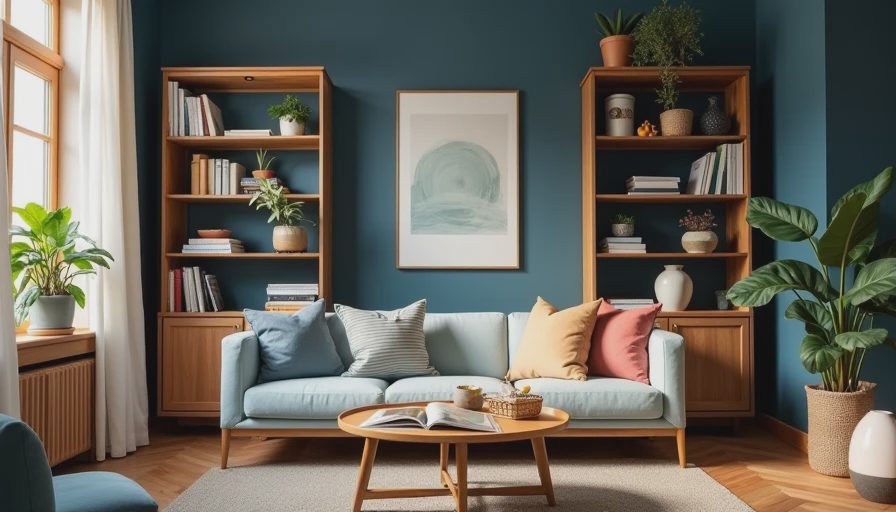
A beautiful shelf feels collected rather than purchased in one afternoon. It has height, breathing room, color, and a few objects that tell you who lives there. Before you buy anything, empty the shelves and wipe them down. Then look at the room as a whole. Notice the upholstery, rug, curtains, wall color, and wood tones. Your bookshelf does not need to match everything, but it should belong to the same conversation.
Start with the large shapes
When people ask how to style a bookshelf like a designer, I usually tell them to begin with the least glamorous step: create a strong foundation. Put the largest books, baskets, framed art, and substantial objects in place first. Do not begin with tiny candlesticks or decorative beads. Small pieces cannot anchor a shelf, so they tend to make the whole arrangement feel fussy.
Work from the bottom upward. The lowest shelf can handle heavier visual weight, such as a stack of oversized books, a woven basket, or a ceramic planter. Middle shelves are usually the eye-level zone, so place something with shape there: a framed photograph, a sculptural vase, or a small painting leaned against the back. Keep the very top simpler unless the bookcase is unusually tall. A few large baskets or one long object will look more intentional than a row of unrelated trinkets.
Vary the direction of your books, too. Stand some vertically and place others in horizontal stacks. A stack creates a useful platform for a small object, while upright books give the eye rhythm. Leave a little space between groups so the shelves can breathe.

Build a palette before you decorate
The best answer to how to style a bookshelf like a designer often comes down to color control. You do not need every object to be beige, but choosing three or four repeating tones keeps a mixed collection from looking noisy. In a warm room, that might mean cream, tobacco brown, muted blue, and soft green. In a brighter space, try white, terracotta, navy, and brass.
Pull colors from items already in the room rather than inventing a new palette for the bookcase. If your sofa has blue piping, repeat that blue in two or three book spines. If your rug includes rust, let a terracotta pot or old hardcover bring it forward. Repetition is what makes a shelf feel designed, even when the individual pieces are inexpensive.
Texture matters just as much as color. Pair smooth pottery with woven baskets, glossy book jackets with linen-covered volumes, and a polished frame with rough wood. A shelf made entirely of shiny objects can feel cold. A shelf with only matte, pale pieces can disappear. Contrast gives it life.
Layer objects without creating clutter
Learning how to style a bookshelf like a designer means knowing when to stop. On each shelf, try combining one book grouping, one vertical element, and one object with an interesting silhouette. That might be a stack of novels, a small framed print behind them, and a rounded vase in front. The frame supplies height, the books supply structure, and the vase softens the arrangement.
Layering does not mean hiding everything behind something else. You should still be able to see what you own. Lean art against the back panel, but allow part of the image to remain visible. Place a smaller object in front only when it adds scale or a useful color note. If a treasured bowl is completely covered by a candle and three tiny figurines, it is not being displayed; it is being buried.
Odd numbers can help when you are arranging a small cluster, but they are not a law of decorating. Two related objects can look lovely together, especially when their heights differ. A pair of brass bookends, for example, may be exactly what a shelf needs. The goal is visual balance, not mathematical homework.
Mix personal pieces with useful storage
A designer bookshelf should work for the people who live there. In a family room, use attractive baskets for board games, chargers, craft supplies, or the inevitable collection of smooth rocks. In a bedroom, a lidded box can hold letters and photographs. In a home office, a magazine file keeps papers from spreading across every surface.
This is where how to style a bookshelf like a designer becomes different from copying a showroom photograph. Make room for the practical things, then make them handsome. A seagrass basket can conceal toy clutter. A wooden box can gather remotes. A fabric bin adds softness to a room full of hard edges. Choose containers that fit comfortably on the shelf, with enough clearance to pull them out without scraping the paint.
I also like leaving one or two shelves deliberately open. Negative space gives the eye a place to rest and makes the meaningful pieces look more important. If every inch is filled, even expensive objects lose their presence.
Add art, plants, and a little movement
Small artwork keeps a bookshelf from becoming a parade of book spines. A postcard in a simple frame, a child’s drawing, or a small landscape can bring in scale and emotion. Leaning art is more relaxed than hanging every piece, and it is easy to change when you want a fresh look.
Plants bring another kind of softness. A trailing pothos can break up a boxy arrangement, while a compact snake plant works well on a darker shelf. Use plants where there is enough light, and protect wood shelves from watering spills with a saucer or waterproof mat. A faux stem is perfectly reasonable in a dim corner; the point is to add life, not create a daily chore.
For movement, consider a small brass object, a handmade bowl, or a candle in a substantial vessel. Avoid placing breakable items where little hands or curious cats can reach them. Style is not worth a midnight cleanup or a frightened toddler. Put the fragile heirloom higher and let the lower shelves hold sturdy baskets and books.
Make the final edit from across the room
Stand back several feet and look at the bookshelf as a whole. This is the part of how to style a bookshelf like a designer that nobody mentions in the shopping lists: editing is more important than adding. Look for one crowded area, one shelf without enough height, and one color that appears only once. Move pieces before buying replacements.
Take a quick photograph on your phone. The camera often reveals a leaning stack, a dark corner, or too many similarly sized objects faster than your eyes do. Shift visual weight from left to right so one side does not feel heavy. If the top half is packed, remove something rather than filling the bottom half to match.
Give the arrangement a week. You may discover that the basket is difficult to reach or that a frame blocks a favorite book. A lovely home is allowed to be adjusted for real life. Refresh the shelves seasonally by changing a few covers, adding a bowl of pinecones in fall, or bringing in lighter colors for spring.
The most welcoming version of how to style a bookshelf like a designer is one that still feels like your family. Keep the novels you reread, the photograph that makes you smile, and the imperfect handmade piece you cannot replace. A soft room is a room that breathes. Let your shelves exhale, too.