
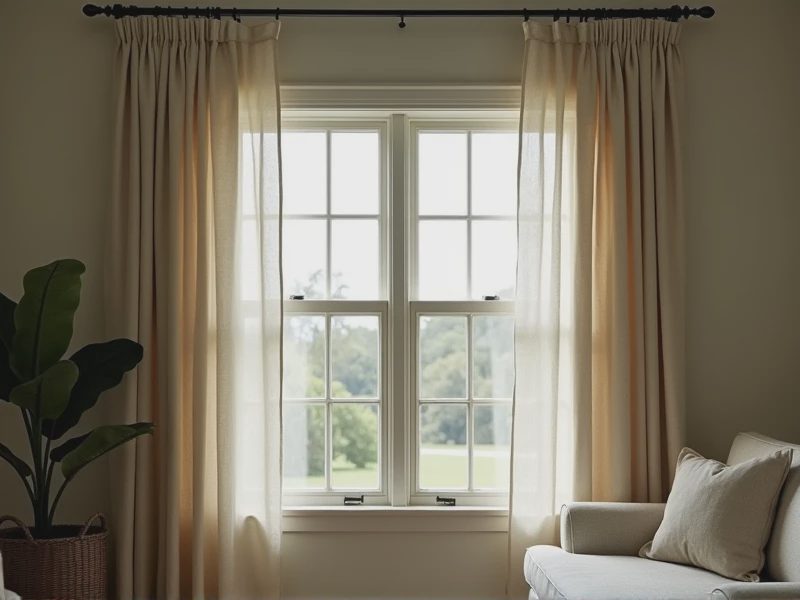
Most people treat curtains and shades as the final decorative layer—something you add after the furniture is in place to soften the edges and complete the look. I treat them as architecture.
A window treatment changes the proportions of a room. It alters how light enters and how the walls meet the glass. It can make a ceiling feel higher, a window feel more generous, or a poorly placed opening feel intentional. When you get it right, the treatment disappears into the structure of the room. When you get it wrong, no amount of beautiful furniture can fully compensate.
The architectural jobs a treatment actually does
First, it redraws the frame. A curtain hung at the correct height and width can visually correct a window that sits too low or too narrow. Mount the rod close to the ceiling and extend it well beyond the frame, and the window suddenly belongs to the wall rather than appearing as a hole punched into it. This is not decoration. This is proportion.
Second, it controls the quality of light as a material. Architecture has always managed light—through orientation, overhangs, the depth of a reveal. Curtains and shades continue that work on the interior side. A sheer linen filters. A lined drape shapes and directs. A simple shade can cut glare without eliminating the view. These are decisions about how the room will feel at 9 a.m. and at 4 p.m., not about which fabric looks pretty in a photograph.
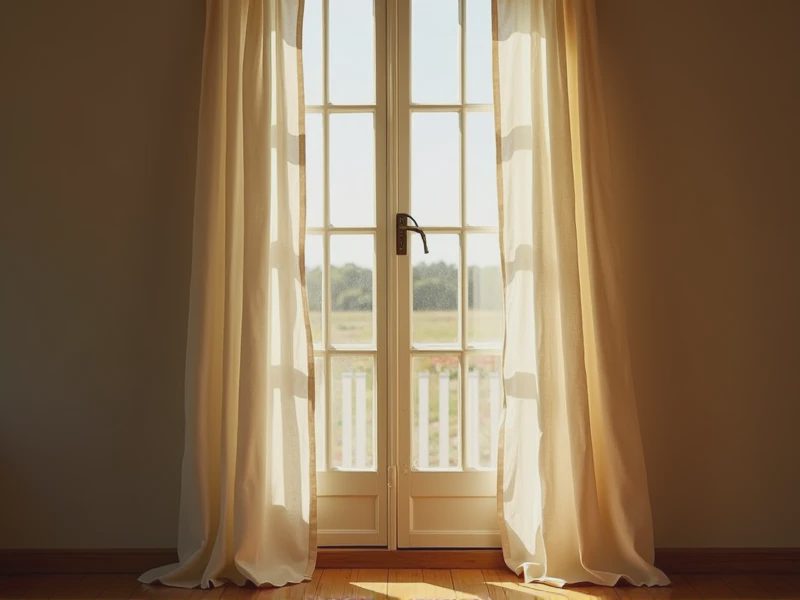
Third, it finishes the vertical plane. An untreated window often leaves the wall feeling incomplete, especially in older houses where the plaster or drywall meets the frame without much ceremony. A well-considered treatment gives that edge a deliberate ending. It tells the eye where the wall stops and the light begins.
Why “accessory” thinking fails
When window treatments are chosen last and treated as optional soft furnishings, they tend to be underscaled, underfull, and underthought. The rod is mounted just above the frame. The panels are only as wide as the window. The fabric is selected for color match rather than for how it will move and filter. The result is a window that still looks like an opening with something hung on it, rather than a resolved architectural element.
I see this constantly in otherwise careful rooms. The sofa is right. The rug is right. The lighting is considered. And then the curtains stop short, or hang too narrow, or use a fabric that fights the light. The whole room stays slightly unresolved because the largest vertical surfaces have not been given the same attention as the floor and the seating.
How I approach them instead
I start thinking about window treatments at the same stage as I think about the major furniture and the flow of light. In a new project they are part of the initial conversation, not the final shopping list. In a finished room that still feels incomplete, they are often the first place I look for the missing architectural clarity.
Fullness, hardware height, lining, and the way the fabric stacks when open are not secondary details. They are the means by which the treatment becomes part of the room’s structure. A curtain that is two-and-a-half times the width of the rod, hung high and wide, with a header that suits the architecture, does not look like an accessory. It looks like it was always meant to be there.
The same is true of shades. A well-fitted Roman or a clean roller shade can give a window the same sense of intention that a carefully detailed casing would. The point is not the product category. The point is whether the treatment is doing architectural work or merely decorating the glass.
Living with the difference
In our own house the curtains are not the most expensive thing in the room, but they are among the most consequential. They correct the scale of the windows. They soften the strong Lowcountry light without shutting it out. They make the walls feel finished. When they are open, the room expands. When they are closed, it gathers. That is not the behavior of an accessory. That is the behavior of something that has been allowed to shape the space.
Once you start seeing window treatments this way, it becomes harder to accept the underscaled, last-minute versions. You notice when a room is still waiting for its vertical edges to be resolved. And you understand why a beautiful fabric on the wrong hardware, at the wrong height, with the wrong fullness, can never quite deliver what the room needs.
A soft room is a room that breathes.
The windows are how it begins—and the treatments are how the architecture lets it continue.
— Caroline