It started as a practical request. Lily was six, her bed was a daily landscape of twisted sheets and half-kicked blankets, and I was tired of rebuilding it while she watched. I also knew that if the bed never felt good to make, she would never want to make it. So we turned it into a small lesson about fabric, order, and the quiet satisfaction of a surface that invites you back.
This is not a story about military corners. It is a story about soft furnishings doing their real job: making daily life feel a little more possible.
Why the bed matters more than the lecture
A child’s bed is one of the first places she experiences textiles as something other than clothes. Sheets against skin. The weight of a blanket. The way a pillow either supports or collapses. If those things feel scratchy, slippery, or too complicated to manage, the bed becomes a site of resistance. If they feel good, the act of putting them back in place starts to carry its own small reward.
I stopped talking about “making the bed” as a chore and started talking about it as putting the room back to rights so it could feel nice again. The language shifted from obligation to restoration. That only worked because the textiles themselves were willing partners.

What we changed on the bed
We simplified. One fitted sheet that actually stays on. One top sheet or a light blanket she can manage by herself. One duvet with a cover that is not so oversized that it becomes a wrestling match. Two pillows—one for sleeping, one small one she likes to arrange. That is the entire system.
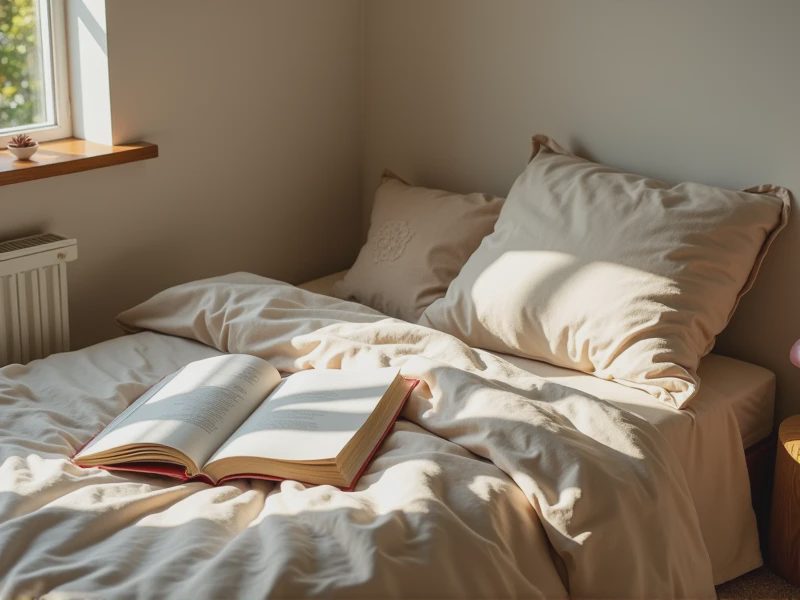
The fabrics matter. I chose a washable linen-cotton blend for the sheets because it softens with use and does not feel cold or plasticky. The duvet cover is a simple cotton that takes a pattern she helped pick, nothing so precious that a juice spill becomes a crisis. Everything can go in the machine. Everything feels decent against bare legs on a warm Charleston morning.
We also made the proportions child-scale. A duvet that is only slightly larger than the mattress is easier to straighten than one that pools onto the floor. Pillowcases that do not swallow the pillows are easier to align. These are soft-furnishing decisions, not parenting techniques, and they changed the daily experience more than any sticker chart.
The method that actually stuck
I showed her once, slowly, how the fitted sheet goes on and why we smooth it. Then the top layer, pulled up with the edge even. Then the duvet, shaken lightly and settled. The decorative pillow last, or not at all if she was not in the mood. The whole sequence takes her a few minutes now. It is not perfect. The duvet is often slightly crooked. One corner of the sheet sometimes escapes. I do not fix it unless she asks.
The important part is that she can complete the task without needing an adult to finish it for her. Success had to be available at her skill level, or the lesson would have collapsed into another thing she watched me do.

What soft furnishings quietly teach
Making a bed teaches spatial order in a form a child can touch. You learn what “smooth” feels like. You learn that fabric has a grain and a preferred direction. You learn that a surface can go from chaotic to calm through a short series of physical actions. These are not abstract design principles. They are embodied ones.
I also noticed that when the bed feels good—when the sheets are soft and the weight of the cover is right—she is more willing to restore it. When the textiles were stiff or complicated, the resistance was higher. The materials were either cooperating with the habit or fighting it.
This is the same logic I use in adult rooms. If the throw is pleasant to fold, it gets folded. If the cushion is easy to plump and feels good under a hand, it stays part of the daily rhythm. If everything requires special care or special strength, it becomes something we avoid until it has to be dealt with.
The larger room
Lily’s bed sits in a room that has had to grow with her. The textiles have had to grow too—from crib sheets to something that can handle chapter books and the occasional breakfast tray. Teaching her to make the bed was never only about neatness. It was about giving her agency over one soft surface in her life and letting the fabric itself make that agency feel worthwhile.
Some mornings the bed is made with care. Some mornings it is made in a hurry with one pillow on the floor. Both are acceptable. The point was never perfection. The point was that she knows how to bring the surface back to a state that feels ready for her again.
A soft room is a room that breathes.
Sometimes the first lesson in that breathing is learning how to smooth a sheet and settle a cover so the day can begin.
— Caroline